When and how to use Will vs Going To
Two forms, two different meanings in English
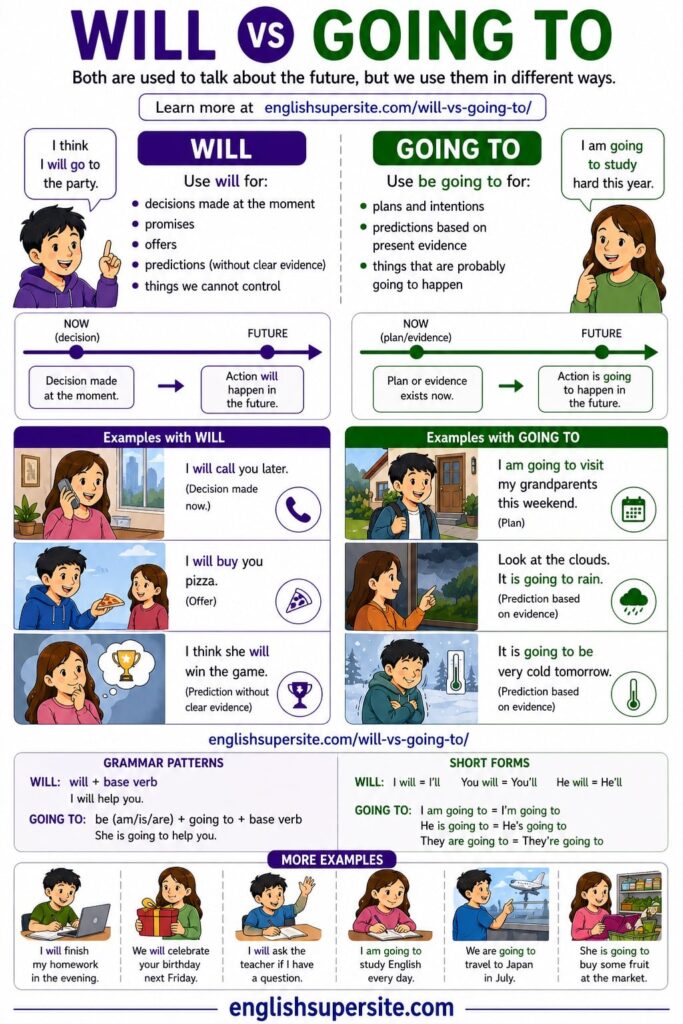
Will and going to are both used to talk about the future in English. However, they are not always used in the same way.
The main difference is simple: use will when the decision is made at the moment of speaking. Use going to when the plan or evidence already exists.
WILL
Structure: Subject + will + base verb
- Decisions made at the moment of speaking
- The doorbell is ringing. I will open the door.
- I forgot my pen. I will ask the teacher for one.
- This box is heavy. I will put it on the table.
- Promises
- I will finish the report before Friday.
- I will call you when I arrive.
- I will not share your password.
- Offers
- I will carry your suitcase.
- I will explain the exercise again.
- I will make some tea for everyone.
- Predictions based on opinion
- I think the exam will be difficult.
- Maybe the meeting will end early.
- I believe your presentation will go well.
Study the following examples:
- I will help you with the exercise.
- She will not come to the meeting today.
- They will arrive before dinner.
- Do not worry. Everything will be fine.
- I think it will rain tomorrow.
- He will not forget your birthday.
- I will send you the file right now.
- Maybe she will change her mind.
- I will not tell anyone your secret.
- The exam will start at nine o’clock.
- I believe the plan will work.
- I will open the window. It is hot in here.
- She will probably pass the test.
- I will get you a glass of water.
- He will study harder next time.
- I think the lesson will be useful.
- I will call you back in five minutes.
- We will know the results by Friday.
NOTE: Contractions are very common in spoken English: I will → I’ll, you will → you’ll, he will → he’ll, she will → she’ll, we will → we’ll, they will → they’ll.
GOING TO
Structure: Subject + am / is / are + going to + base verb
- Plans and intentions
- I am going to visit my cousin this weekend.
- She is going to take an English course next month.
- We are going to start the project on Monday.
- Predictions based on present evidence
- The glass is at the edge of the table. It is going to fall.
- He is driving too fast. He is going to have an accident.
- The kitchen smells smoky. The food is going to burn.
Study the following examples:
- I am going to study English every day this month.
- She is going to start a new job next week.
- They are going to travel to Brazil in the summer.
- Look at those clouds. It is going to rain.
- He is going to move to a new apartment.
- We are going to have a meeting tomorrow morning.
- I am going to cook dinner tonight.
- She is not going to accept the offer.
- The price is going to increase next year.
- I am going to read that book this weekend.
- He looks pale. He is going to be sick.
- They are going to open a new office in the city.
- I am going to call my parents tonight.
- The bus is going to leave in two minutes. Run!
- She is going to finish the course in December.
- We are going to visit our grandparents at Christmas.
- I am not going to eat meat this week.
- The team is going to win the championship.
NOTE: Sometimes will and going to can both be correct for general predictions: “I think the lesson will be useful” and “I think the lesson is going to be useful” are both acceptable. However, when there is clear present evidence, going to is the better choice. Contractions in spoken English: I am going to → I’m going to, you are going to → you’re going to, he/she is going to → he’s/she’s going to, we/they are going to → we’re/they’re going to.
Common Mistakes
Mistake 1 — Using “going to” for a sudden decision. The doorbell is ringing. I am going to open the door. ✗ — The decision is made now, so use will: I will open the door. ✓
Mistake 2 — Using “will” for a plan that already exists. I booked the hotel yesterday. I will travel on Saturday. ✗ — The plan already exists, so use going to: I am going to travel on Saturday. ✓
Mistake 3 — Forgetting the verb “be” before “going to”. She going to study tonight. ✗ — Always use am, is, or are before “going to”: She is going to study tonight. ✓
Final Review
Use will when the decision happens at the moment of speaking, when you make a promise, when you make an offer, or when you give a general opinion or prediction about the future.
Use going to when the plan or intention already exists before the moment of speaking, or when present evidence shows that something is about to happen.
When in doubt, ask yourself: Did I already plan this? If yes, use going to. If the decision is happening right now, use will.
Vocabulary Quiz + Pronunciation
Study Also:
Vocabulary Quiz + Pronunciation
Abbreviations Cohesion and Coherence Collocations Common Mistakes Comparative Conditionals English Grammar ESL First Conditional Frequent Errors Future Continuous Future Perfect Future Perfect Continuous Future Simple Future Tense Going To Homonyms If Clauses Interjections Learn English Logical Flow Mixed Conditionals Past Continuous Past Perfect Past Perfect Continuous Past Simple Plural Present Continuous Present Perfect Present Perfect Continuous Present Simple Pronunciation Question Tags Quiz Quotes Second Conditional Simple Future Simple Past Simple Present Spelling Superlative Third Conditional Will Word Forms Zero Conditional